

So You Think You’re Virile #02
Getting Your Genetic Envoys Race Ready

In this issue:
How sperm quality shapes your genetic legacy
How the next three months shape your genetic cargo
How today’s habits change how your genes actually perform and your future child’s health
When I got pregnant with our first, my husband started holding my hand every time we crossed the road.
“Why?” I asked.
“I’m protecting my genetic legacy,” he said.
You’ve gotta laugh, but he wasn’t wrong.
Men can go from vaguely aware of “the swimmers” to fiercely protective of their genetic future in about three heartbeats. Pride kicks in when there’s a future self in play.
I mean, since when have women named their daughters after themselves? This nod to immortality was brought home to me reading The Names by Florence Knapp, where a mother registers her baby’s name under the husband’s assumption that of course he will be named after him, just as he was. She hesitates, wondering if she’s just copying a name or copying a man.
That’s legacy in a nutshell: the sense that what you pass on isn’t just a child, but a version of you. The trick is earning that pride earlier, when there are millions of potential “yous” in a teaspoon of semen. It may not feel as real as a few cells on an ultrasound screen, but this is when your legacy is still being created. What shape those potential versions of you take depends on what’s going on inside your own body.
The Comfort Blanket of Male Fertility
You’ve heard the line: “Don’t worry mate, you make new sperm every day.”
True, but misleading. Yes, production never stops. Yes, the numbers are huge. That doesn’t mean they’re all in racing shape. Sperm counts have dropped drastically in recent decades, and quality has slid with them. Less Olympic relay team, more Sunday social squad.
There are still some good performers in there, but “survival of the fittest” doesn’t help if you’ve lowered the bar for what “fit” means.
Beyond the Factory Floor: Sperm As Envoys Of Your Genes
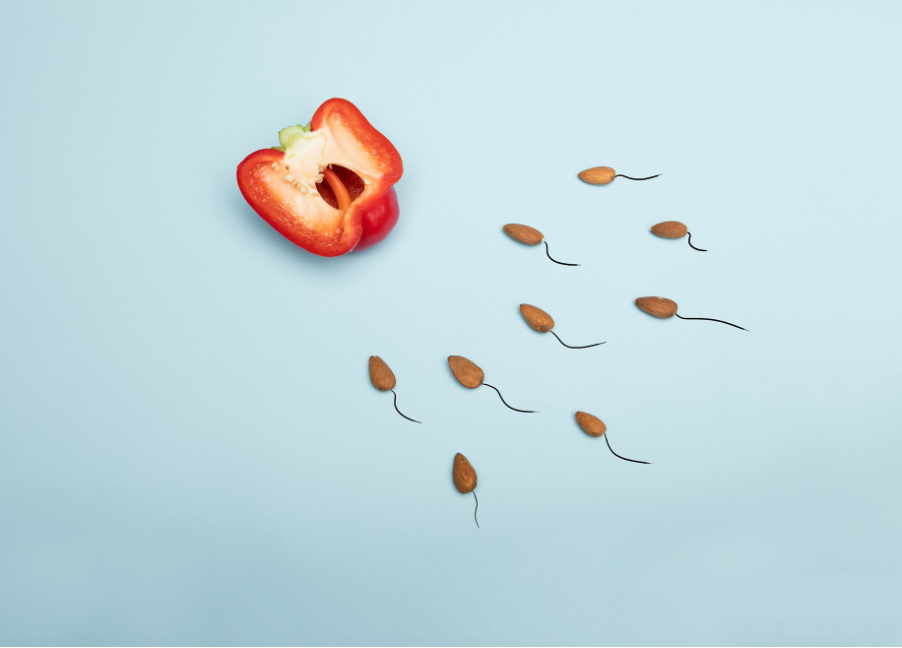
Sperm aren’t just tiny swimmers racing for a medal. They’re couriers, each one a delivery vehicle for your half of the blueprint that builds a human.
To go the distance they strip down to bare essentials:
a head packed with DNA
a mid‑piece loaded with mitochondria for fuel
a tail built for propulsion
That minimalism makes them fast but fragile. Oxidative stress (think wrecking balls from smoking, pollution, pesticides), poor metabolic health, even persistent inflammation can batter the DNA cargo, fragment it, or sabotage the battery pack driving the tail.

Your Life Talks To Your Sperm, Constantly
Your DNA code is fixed. But how that code is packaged and protected inside each sperm depends on the 70–90 day window before ejaculation, the full development cycle from raw precursor cell to finished swimmer.
During that time, your genes are responding to the daily signals from:
what you eat, drink and inhale
how you sleep, move and recover
exposure to heat, phones, laptops, smoke, chemicals or chronic stress
your gut and immune systems
and more…
This signalling impacts how intact that DNA remains. Whether your DNA arrives like a well‑bound book or a pile of loose pages depends entirely on the conditions you’ve set. That “loose pages” scenario has a name: DNA fragmentation.
DNA fragmentation is what happens when the DNA inside sperm has been broken into pieces. The genetic story is technically still there, but it’s harder for an embryo to read cleanly.
That kind of damage shows up as trouble conceiving, early miscarriages, or embryos that start but don’t develop properly, even when a conventional semen analysis looks “normal” (unless a DNA fragmentation test has been added to the sample).
In IVF and ICSI, higher sperm DNA fragmentation is linked with lower implantation and live‑birth rates.

What “Genetic Legacy” Really Means
Even if your DNA arrives intact, that doesn’t guarantee your genetic legacy is optimal. This also depends on how well those genes can actually function and stay protected at the moment your sperm meets egg.
So, two men could deliver intact (and let’s assume identical) DNA on a lab report, but the way that DNA is actually expressed can be very different. One might be passing on physiology that runs steadier blood sugar, more resilient stress responses, more balanced immunity and better detox capacity, while the other carries patterns of expression that create vulnerabilities on all these fronts.
What are the implications for your future child?
Mounting research and clinical evidence suggest that these differences in how your genes are expressed before conception can shape a child’s long‑term metabolic balance, stress resilience, immune patterns and even aspects of brain development.
The signals you send your genes through food, sleep, stress and environment, in the years before conception, and certainly in the 90-day spermatogenesis runway, are establishing a pattern of gene expression that will be passed on.
Fixed Genes, Personal Weak Spots: Your SNPs
Your genes are fixed, but they are not all equally sturdy. We all carry variants, SNPs (single nucleotide polymorphisms), that are more sensitive to the evolutionarily incoherent signals of modern life.
Everyone carries a unique set of variants in genes that influence biological pathways related to inflammation, ability to handle oxidative stress, detoxification, insulin handling, hormone metabolism, DNA repair, etc.
We’re not talking dramatic disease‑causing mutations, just subtle but material differences in how these pathways run, and in how hard the modern environment can derail them.
In a world of ultra‑processed food, poor sleep, sedentary lifestyle, constant stress and environmental exposures, those more vulnerable pathways can have outsized impacts.
If you know which genes are your personal weak spots, you can prioritise the labs you need to track, your eating patterns, including targeted nutrients, lifestyle habits and specific detox strategies that protect them.
Virility, Reclaimed
True virility goes beyond “getting your partner pregnant”. The man who prepares his biology before conception is strategic. He’s building the conditions for resilience and lifelong health potential in the child he’ll one day call “my kid”.
From this standpoint, you could say that true virility is legacy stewardship.
Your Three‑Month Legacy Window
If conception is on your horizon, soon or someday, you’re already in the prequel. Every batch of sperm you make today will audition about three months from now.
Here are the very basics to focus on:
Metabolic strength: build lean muscle, eat enough protein and whole foods, steady your blood sugar, ease up on processed food and alcohol.
Low oxidative stress: quit smoking, vaping, cannabis (and all drugs obviously), moderate alcohol, move heat and electronics away from your lap, clear up obvious home or workplace chemical exposures.
Rhythm and recovery: protect sleep, manage stress, and actually switch off so you’re not running on adrenaline 24/7.
Asceticism and punishing self‑denial are not the strategy here. The strategy is intelligent care that creates a body that turns out an Olympic‑ready swim squad, not sperm that limp across the finish line.
For the Inside of Your Gym Locker:
90 days: this is the (minimum) window where today’s choices shape developing sperm and the genetic cargo they carry.
Same DNA, different expression. Your habits decide.
SNPs flag vulnerable spots in insulin, detox, stress, inflammation, hormones, etc.
Food, sleep, training, stress and environment are your main levers.
Precision support
If you’re curious about your DNA, the Baby Ready DNA Blueprint turns your genetics into a practical preconception plan. Learn more here: Work with me.
Warmly, Sonja
New Here? Head to the About & Welcome pages for why I started Baby Ready Health and a bit about me.
Issues are free for now. If you’re someone who likes to build things early, you can become a founding member. Or simply subscribe and follow along.
This post is for educational purposes only and is not medical advice. Always consult a qualified practitioner before making decisions about your health.
REFERENCES:
Bale, T. L. (2015). Epigenetic and transgenerational reprogramming of brain development. Nature Reviews Neuroscience, 16(6), 332–344.
https://doi.org/10.1038/nrn3818
Donkin, I., & Barres, R. (2018). Sperm epigenetics and influence of environmental factors. Molecular Metabolism, 14, 1–11.
https://doi.org/10.1016/j.molmet.2018.02.006
Jenkins, T. G., & Carrell, D. T. (2012). The sperm epigenome and potential implications for the developing embryo. Reproduction, 143(6), 727–734.
https://doi.org/10.1530/REP-11-0450
Ni, W., Yang, X., Wang, Y., et al. (2025). Impact of sperm DNA fragmentation index on assisted reproductive outcomes: A retrospective analysis. Frontiers in Endocrinology, 16, 1530972.
https://doi.org/10.3389/fendo.2024.1530972
Zhao, J., Zhang, Q., Wang, Y., & Li, Y. (2014). Whether sperm deoxyribonucleic acid fragmentation has an effect on pregnancy and miscarriage after IVF/ICSI: A systematic review and meta‑analysis. Fertility and Sterility, 102(4), 998–1005.
https://doi.org/10.1016/j.fertnstert.2014.06.033
Thank you! And I have soooo much more fun and clinically applicable things to say on the subject.
Very funny and too true! You tell 'em gal!